Revealing the invisible dynamics that influence your life
A space to explore family patterns, invisible bonds, and systemic movements that cross generations and influence relationships, decisions, and the sense of belonging.
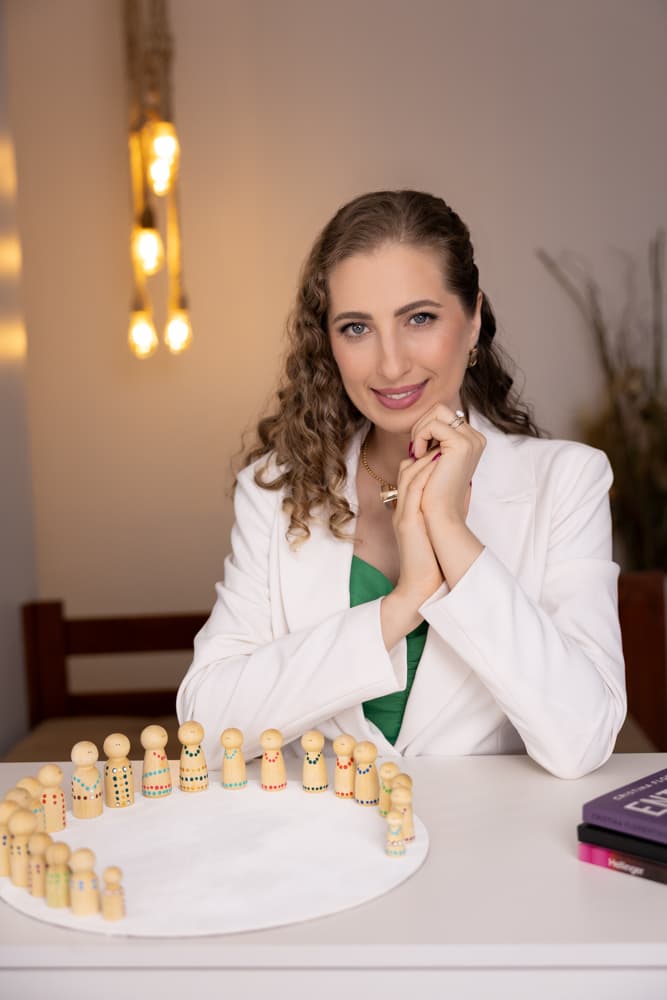
Many people come to this work without knowing exactly what the problem is.
Each person's life is part of a larger story. We all belong to family systems that connect generations through bonds, memories, and shared experiences. Often, important aspects of family history remain invisible, yet they continue to influence how we live, relate to others, and make decisions. The systemic perspective invites us to expand our awareness of these connections, recognizing that each person occupies a place within a story that is larger than themselves.
- repetitive relationship patterns
- persistent family conflicts
- a sense of stagnation in certain areas of life
- anxiety or tension without an apparent cause
- guilt or responsibilities that don't seem to belong to the person
- a feeling of not being in one's rightful place in life
They simply feel that, despite effort, awareness, or rational decisions, something continues repeating or remains unresolved.
This does not mean weakness. It often points to systemic dynamics not yet recognized.
What are Family Constellations?
Family Constellations are a systemic approach that allows us to observe how family histories, bonds, and dynamics may continue to influence present life. According to the observations developed by Bert Hellinger, every family functions as a living system connected through bonds that extend across generations. When significant events are not acknowledged within the family story, those events may continue to influence the system over time. Constellations make it possible to observe these dynamics directly and expand awareness of family relationships.
How a Constellation Unfolds
- people (in group sessions)
- objects, figures, or markers
- bodily perception and observation of the systemic field
Formats
Individual Constellation
A more intimate and focused session where the theme is explored at the participant's pace. Possible tools include bodily awareness, objects, figures, or anchors, and observation of the systemic field.
Group Constellation
In group sessions, participants may represent members of a family system. This format allows the dynamics of the system to be observed directly. Even those who participate only as observers often report important reflections about their own history.
In-person (Winter Garden, FL) and Online
Examples of themes that can be explored
- repeating relationship patterns
- persistent family conflicts
- difficulties with parents
- feeling of not belonging in the family
- difficulty making important decisions
- feeling stuck in life
- fear of moving forward
- blocks related to career or prosperity
- difficulty finding professional direction
- feeling unable to progress despite efforts
- themes related to ancestry
- important events in family history
- feeling as though carrying a burden that may not be entirely personal
These are only examples. Any life situation that calls for deeper observation may serve as a theme.
What it means to occupy your rightful place
From a systemic perspective, every person belongs to a family system and occupies a unique position within it. Parents have their place, children have their place, and siblings have their natural order within the family. When this order is recognized, relationships tend to find greater clarity and balance.
Occupying one's place means recognizing the position each person holds within the family story: seeing parents as parents, ancestors as those who came before, and oneself as part of the continuity of life.
This is not about distancing oneself from family or judging it, but about recognition. Each person belongs to the system and occupies a place that is uniquely their own.
When this movement happens, many people report greater clarity about their own story, more freedom to follow their path, and a deeper sense of peace with their origins.
Why family patterns may repeat
In many families it is possible to observe that certain themes seem to appear repeatedly across generations. Sometimes this manifests as: • similar dynamics in relationships • stories of family conflict or rupture • recurring difficulties in certain areas of life • similar emotional or behavioral patterns among different family members These repetitions do not always occur consciously. Often, younger family members do not fully know the stories that came before them, yet they may still feel the influence of these dynamics. Invisible bonds within the family system From a systemic perspective, each family forms a network of bonds among its members. These bonds are not only biological or social. They also include emotional connections, shared experiences, and significant events in family history. When important events are not acknowledged within the system — such as losses, exclusions, or difficult experiences — these elements may continue influencing the family over time. Invisible loyalties One of the central observations of systemic work is what is often called invisible loyalties. These loyalties may appear when a family member unconsciously identifies with the experiences or destinies of those who came before. This does not occur through rational choice. It is a movement connected to belonging within the family system. In many cases, this type of identification may appear through: • similar behaviors • emotions that are difficult to explain • repetition of certain life situations The role of recognition When important family stories are recognized and included in the system's memory, many people report that certain patterns lose their intensity. Systemic work invites us to look at these stories with greater awareness, expanding our perception of the bonds and movements that are part of our family origins.
What constellations are not
- not a religious practice
- does not involve mediumship
- does not seek to interpret a person's life definitively
- does not replace medical or psychological care
Systemic work invites observation of family dynamics and recognition of family history. While many people report new insights through this process, it is also important to recognize the limits of the approach. Family constellations do not seek to explain life definitively nor offer absolute interpretations. The work is based on phenomenological observation and respect for each person's experience. Family constellations are a complementary practice of systemic observation and personal development, and do not replace medical or psychological care when needed.
I want to understand more deeply
Family Constellations offer a space to observe the invisible dynamics that are part of family history.